Shares body-affirming art by Jessi @JessiJeannn


I just love her body affirming art and messages! Do you have a favorite message or art to share?

I just love her body affirming art and messages! Do you have a favorite message or art to share?

Hi everyone. For this week’s Self-esteem Saturday, I thought it made sense to talk about Women’s History Month. This is a month that highlights women and their contributions to family, politics, literature, all the forms of art, science, math, psychology, technology, and so much more.
Before we had Women’s History Month, the recognition of women was limited to International Women’s Day (March 8th) and in the U.S., Women’s History Week in Santa Rosa, California. As the movement spread across the country, there was a call for national recognition. In February 1980, President Jimmy Carter issued the first Presidential Proclamation declaring the week of March 8th, 1980 as National Women’s History Week. This continued until March 1987 when Congress passed additional resolutions requesting and authorizing the President to proclaim March of each year as Women’s History Month. Since 1995, each president has issued this annual proclamation.

The majority of the text in this blog comes from (https://www.womenshistory.org/womens-history/womens-history-month). There are too many amazing resources to share here, but I encourage you to check out their events, videos, social media cards, find activities for children, to name a few.
Imagine a gender equal world.
A world free of bias, stereotypes, and discrimination.
A world that is diverse, equitable, and inclusive.
A world where difference is valued and celebrated.
Together we can forge women's equality.
Individually, we're all responsible for our own thoughts and actions - all day, every day.
We can break the bias in our communities.
We can break the bias in our workplaces.
We can break the bias in our schools, colleges and universities.
Together, we can all break the bias - on International Women's Day (IWD) and beyond.
Whether deliberate or unconscious, bias makes it difficult for women to move ahead. Knowing that bias exists isn’t enough, action is needed to level the playing field.
Are you in? Will you actively call out gender bias, discrimination and stereotyping each time you see it?
Will you help break the bias?


Were you lucky enough to be a client of mine in the past few months? If so, you received this tool box as a gift. I hope you have continued to build upon those initial strategies we determined work for you and you find the tool box helpful.
The intention of the tool box is two-fold.
There is only one box because what we recognize as coping strategies in the moment are also ways to bring joy preventively.
I’ve created a handout of Grounding Techniques you can add to your tool box. These are particularly helpful for dealing with distressing thoughts and feelings. In particular, they are helpful for folks who have PTSD, self-harm urges, traumatic memories, and who might dissociate. Grounding techniques have also been found to help anxiety and substance use disorders.

If you have any questions or comments, I would love to hear from you. Also, if you were not a client of mine, don’t worry. You can contact me about purchasing a tool box.
Have a great day!
I recently came across Stephanie’s art and could not wait to share it with you! Stephanie is a self-esteem and body-confidence illustrator, author, and speaker.

Clicking “love,” “love,” “love” all over her work.
A common question I am asked is “how do we develop our sense of self-worth and a positive self-esteem?”
From my perspective, our self-worth begins to form in infancy. As a newborn, we sense our value through basic caretaking – keep me fed and keep me comfortable. When we show delight in children through skin-to-skin contact, replication of sounds (playing), and learning how to interpret the early “talking” of the various cries, babies feel our love and connection.

There are countless ways we can continue to show children they are valuable, worthy, and loveable as they grow. We start with the basic needs and pay attention to many other needs as infants become, toddlers who then become preschoolers, and school-aged children. Those school-aged kids keep on growing until they are in middle school or junior high ending up in high school. (Yes, some follow that up with further education, but for simplicity’s sake, you will hopefully, allow me a bit of leeway. 😊)
As peers become a bigger influence and children begin to experience disappointment and hurt, parents can help their children learn to identify, understand, and value their emotions. Parents will continue to be that “safe space” kids can come back to no matter how old they are. They will also teach their children how to identify, express, and then manage their emotions. How to problem-solve and advocate for themselves. The art of forgiveness, while learning how to accept feedback, use it appropriately and move past the words and actions that come to us with the intention of harm.
Teaching children it is okay to hurt because they can use those experiences to learn and grow. Helping them see the difference between hurt and harm. Reenforcing the value and respect that has been taught along the path of life.
While our healthy and good-enough parents will always be our safe space, we strive for the independence to live life as healthy adults. We will continue to choose people who will find joy in us, see the value, give the respect, maintain the connection, and demonstrate love and affection.
And this, my friends, is the journey of positive self-esteem that includes self-worth and value in ourselves, as well as the desire to continue to grow and learn.
For those of you who had parents who were unable to take you along this path, or who had parents who experienced bumps in the road taking you all off track, detours, dead ends, and accidents, YOU are in the driver’s seat now. You can choose your path and find your value and self-worth and love.
As E.E. Cummings so eloquently stated,
“We do not believe in ourselves until someone reveals that deep inside us something is valuable, worth listening to, worthy of our trust, sacred to our touch. Once we believe in ourselves we can risk curiosity, wonder, spontaneous delight or any experience that reveals the human spirit.”
Finding that space on your own, circles back to those adult relationships you find, create, and bring into your life. Friends and mentors can help you connect to that sacred space of belongingness and love. Sometimes, you would benefit from working with a good psychologist or therapist.
If you find yourself struggling and uncertain, please feel free to reach out. Remember, Relationship Solutions Center focuses on

creating closeness and transforming relationships from the inside out.

I recently had someone ask why I have been sharing articles about polyamory and kink.
For those who do not know, one of my areas of specialty includes working with folks who fall anywhere in the spectrum of “alternative sexuality.” Sexuality is broken down to include anatomical sex
As you can see, there are several areas of sexuality where a person can identify as “non-traditional” or “alternative.” While a person’s mental health is not considered unhealthy just because they fall somewhere along the alternative spectrum, working with a sensitive and aware psychologist is often a preference as it can play a role in the issues and concerns brought into therapy.
So, I have been posting information to educate all of you, destigmatize alternative sexuality, and address concerns specific to folks in these communities.
While there is not one all-inclusive pride flag, I have found 3 that encapsulate the possibilities in terms of sexuality and I’m including them here. I can explain the meaning of each flag in a separate post if you are interested.
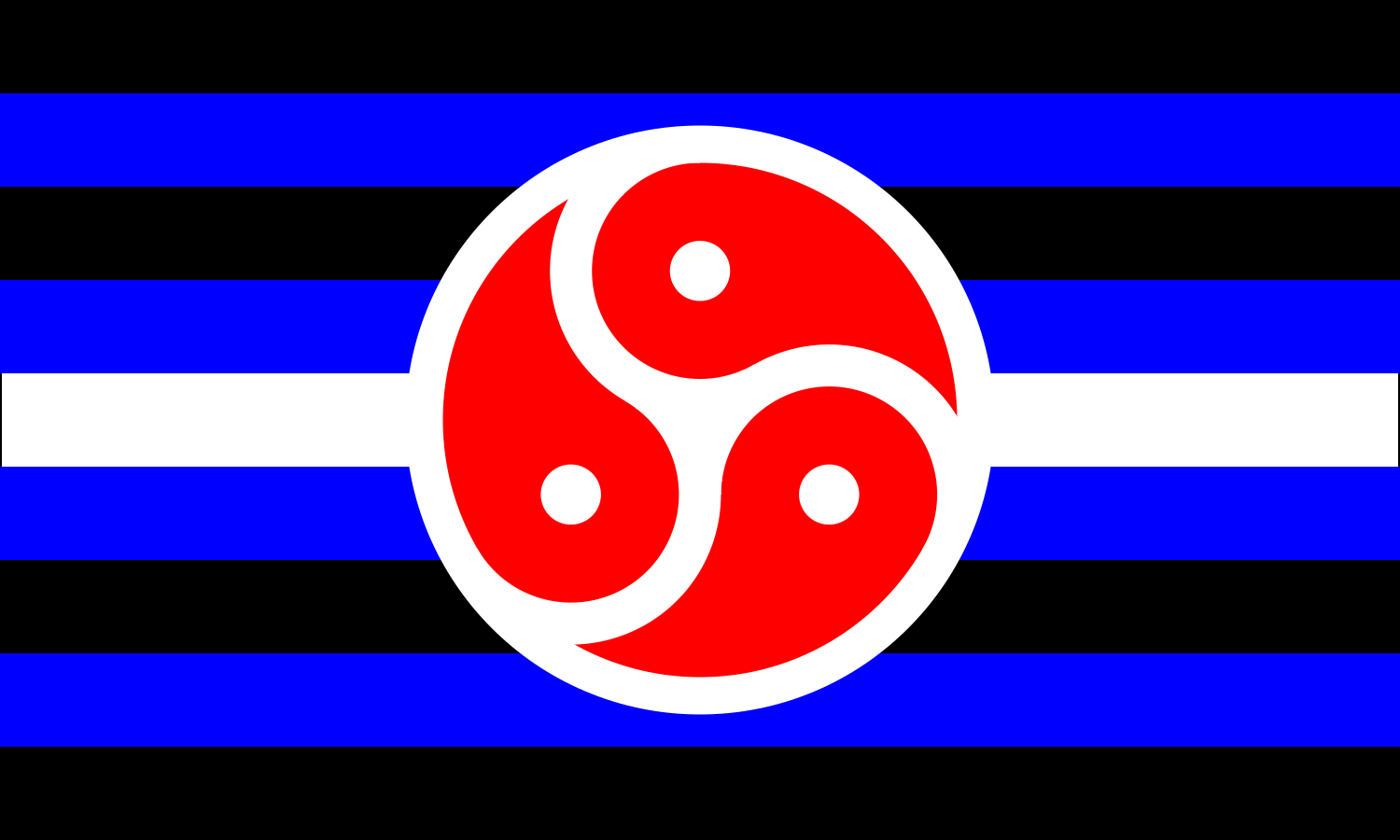
BDSM Pride Flag

Polyamory Pride Flag


Over the past two weeks, I have had many conversations about racism and what I have noticed is we need to begin by understanding racial identity development.
People of all skin colors and races go through an unconscious process of seeing themselves as having a particular skin color or race in the preschool years.
Beyond the rudimentary identification of skin color, we then develop ideas of what it means to be that skin color/race and what it means to be a different color/race.
From there, we can look at two models.
Janet Helms created a model for racial and ethnic identity development for White people in 1990.

William Cross developed the Nigrescence Model for Black People in 1991. The Nigrescence Model can be applied to people in other racial and ethnic groups.

Many of you are struggling with how to help. How to feel empowered to change the system(s). It starts here. Look inside yourself and see if you can identify what stage you fall within. If you need help understanding this and determining where you are, please feel free to reach out via email or a phone call.
Never stop growing.
I have been chatting with Dr. Ragsdale over the past couple of days. His letter was shared via the Illinois Psychological Association listserv. I found it very powerful. With many of my sessions this week focusing on processing George Floyd’s murder, I continue to seek resources to help as you process your own reactions. As our conversation continues, I will happily share resources.

Please feel free to reach out if you need a place to talk. We’ve had a lot to manage over the past 4 months. I am here for you.
What happens to divorcing couples in the middle of a pandemic?
Where can parents go for help with custody disputes when the courts are closed?
Families are in crisis, and they don’t know where to turn.

On May 27th at 12:00 p.m. (CST), the International Academy of Collaborative Professionals is hosting a FREE information session about Collaborative Practice and its benefits.
Learn new ways to get your clients the help they need and expand your local referral network.
Local civic, social, business, religious, and community groups, as well as professional associations, are invited.
As a service provider, you see firsthand how COVID-19 is devastating our community. Let’s work together to provide solutions.
Seats are limited. Register now.
https://www.collaborativepractice.com/civicrm/event/register?reset=1&id=83